
25-b. Serendipities
Story Codes: Reflections on a Lifetime Writing Novels

To number this episode of Story Codes as 25-b, with the ‘b’ being an outlier, serves two purposes. First, an apology, as my previous post was shown as No. 25 when it should have been designated No. 24. Thanks for understanding that I’m an old guy with an unreliable narrator for a brain. Or, at least, an unreliable adding machine. Also, since I’m continuing with the notion broached in the previous post about joyful discoveries along the way while writing novels, the ‘b’ designation fits, as this is a happy sequel. As mentioned in that post, discovery is a joyful aspect to reading fiction and a very good reason to do so, but discovery is also grafted onto the process of writing. When the writer finds something that’s unexpected yet useful, when the moment crystallizes as being the right note for a current project, it comes across as a special magic. Writers slaving in their silences need to be entertained by the occasional startling ka-bong! in their heads to aid them to keep going.
Examples follow. I’m taking the first one from a play I wrote which was first mounted Off-Broadway and later in Montreal. Allow me to begin with a few bells and whistles about that particular theatrical experience.

Writing for theatre is a departure from writing novels on various fronts. The writing itself presents its own challenges as dialogue must carry the action, rather than the action of a novel being supported by the dialogue. I believe I’ve mentioned in the past that my first novel was notable for the scarcity of dialogue, and now, in a play, that’s pretty much all I had. That the playwright is in league with various theatre artists — actors, directors, lighting and design and costume artists, even carpenters — is a 180 degree shift for the novelist accustomed to four walls that surround a desk. The writing experience can also be very different — early on, it was for me — in that the work has the potential (not always, I’ve learned subsequently) to go alarmingly fast. My first play, Long, Long, Short, Long was written in nine or eleven days (For some reason I know it wasn’t ten!) Later, I was approached by an actor who’d performed in a couple of my plays since then, Brett Watson, who asked that I write a two-hander. We discussed what that might mean. I thought about it, then wrote the play, Zarathustra Said Some Things, No? in all of two days. I should add, two sleepless days. Full bore intensity, a reflection of the play itself. An Off-Broadway theatre accepted it, and we began the process of putting it up.
It’s never easy, but this time around the obstacles were singular.
The director had on-and-off days. He’d fall into a depression and wander off for hours at a time, not to be seen or spoken to. Yet we persevered through rehearsal and had a set constructed which could be packed away to travel with us from Montreal to New York. After much pain and interpersonal drama, the director, stage manager, our two actors and the worried playwright were off to the Big Apple.
Yeah. Exciting.
In ways that were unexpected.
At the border, back some twenty-odd years ago, our troupe and our rental truck carrying the set was taken aside. The truck, filled with thousands of props, construction materials and costumes, was searched. A large red dildo was one of many items called into question — why are you importing a dildo into the United States? — though mainly what was called into question was our reason for existing and our plan to work in the US, even though our paperwork to do so was in perfect order. Our only problem was intransigent border guards — a serious hiccup. We had to get to New York, set up, which included erecting the set on site but also finding places to live, then perform the opening show within 72 hours. The guards were threatening to hold us at the border for much longer than that and perhaps not admit us at all. Even though this was prior to the current Washington administration — who would even bother today? never mind who would want to? — we were being treated with contempt and our appeals concerning an unforgiving and tight schedule were relevant to no one at the border.
They were not relevant, that is, until we put a call through to the theatre in New York to say we’d either be late or would not be showing up at all. We subsequently learned how stuff gets done in the United States of America. The owner of the theatre, thankfully for us, was friends with a New York congressman. The owner complained to said congressman who literally phoned up the border guards to get us on the move, and we were treated like royalty from that moment on. The guards were abruptly solicitous and anxious that our play go up with no further hindrance. Suddenly, they were theatre buffs and wanted to know all about it. Stunning, to witness the about-face in attitude brought on by the flexing of political might. Our props were carefully returned to the truck, including the dildo, and we were on our way, late but within a workable time-frame, and the play opened on time.
We enjoyed an 8- or 9-week run (my faulty memory again) to absolutely splendid reviews.
On this trip I learned what the term Off-Broadway actually means. The designation does not refer to territory close to Broadway, at least not necessarily. Off-Broadway refers to professional theatre companies in New York whose seating capacity come in between 100 and 499. If a theatre has 500 seats or more it is deemed to be Broadway, although in this case the location must also be within what is known as the “Broadway Box.” By contrast, under 100 seats is called Off-Off-Broadway. There is even an Off-Off-Off where the ticket price plummets. Our Theatre 54 was Off-Broadway although physically just around the corner from the Ed Sullivan Theatre and quite a few stories up, about ten. While having to take an elevator to the appropriate floor diminished the ambiance, or so I found, the theatre was well-suited for small productions with an ample lobby that conveyed an appropriate sense of anticipation. As well, as our set lugged in from Montreal was meant to capture a high Parisian apartment (photo below), the elevator access was perhaps apt.
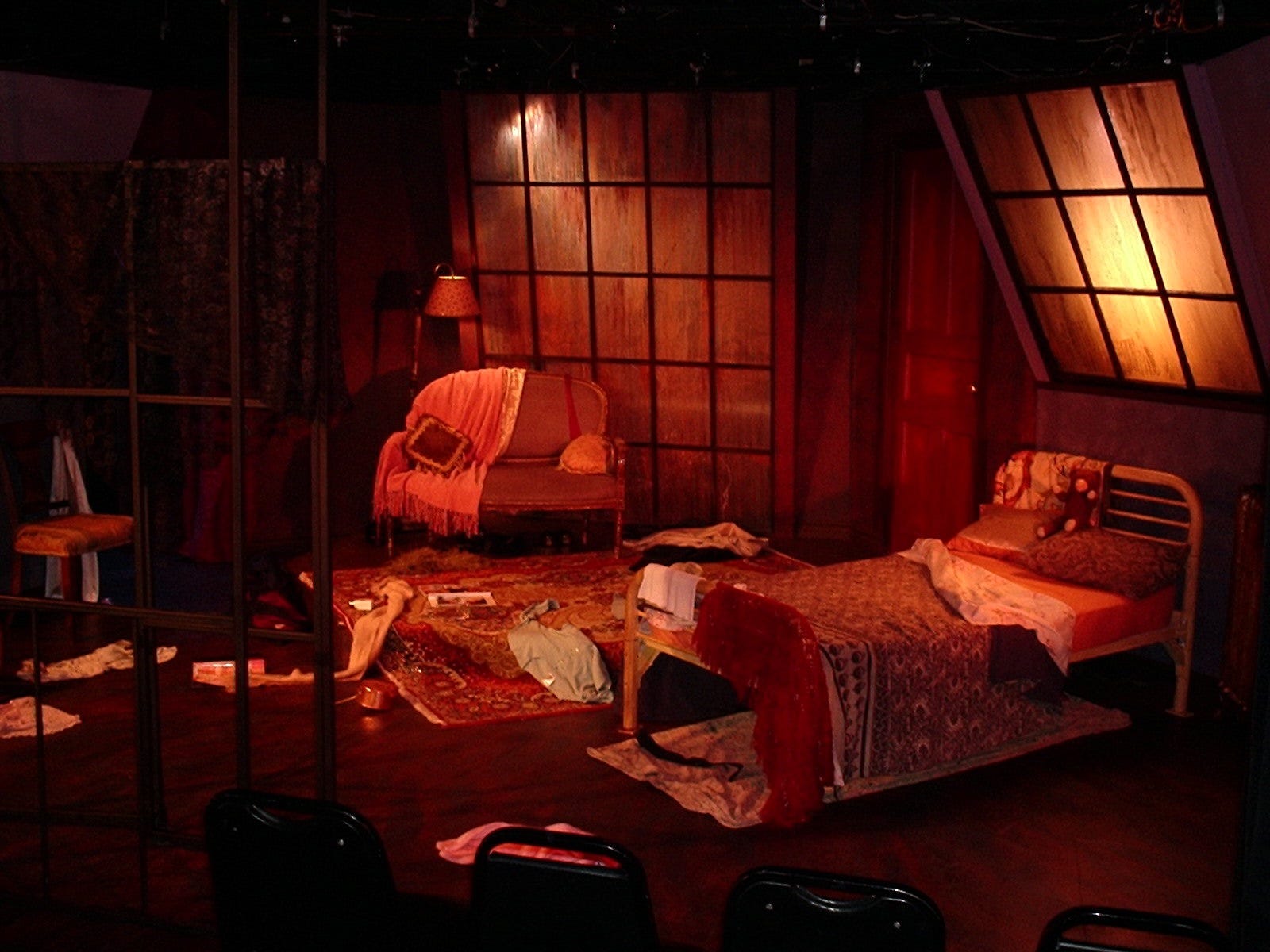
The joyful discovery in the writing? Right. I haven’t forgotten. I have no idea where I found this, although it’s not at all secret information, just not generally known. Stumbling across the item during my two-day splurge writing Zara, it fit like a charm into the play. The drama conveys an engagement between two disparate ex-junkies, Adrienne and Ricky, lovers, who are flailing away at each other, partly as a way to diminish the other, and partly as a way to stay alive and keep the other alive while always being on the cusp of mutual suicide. A tough play for sure, so that Adrienne’s brief monologue about Mary Queen of Scots — my serendipitous discovery — serves as an outlier in the context of the play’s brutality and is a breather for the audience as well. That the play is set in Paris suits the context.
Ricky
What would you like me to do?
Adrienne
The shawl. It’s time.
Ricky removes the shawl from the French doors. The sun’s bright on the balcony.
Later than I thought. Now open the doors.
Ricky opens the French doors. Sounds of traffic, not loud, come up.
Step outside.
He steps outside.
Look up.
He looks up.
Tell me what you see.
Ricky
Not a cloud in the sky.
Adrienne
So, it’s better than yesterday. Is today our day?
Ricky comes in and closes the French doors. Traffic noise ends. He will pick things up and arrange a backpack on a small table, occasionally placing in it an item from the floor.
Ricky?
Ricky
Today’s perfect, Adrienne. You want breakfast?
Adrienne
Since today’s such a big day, I’d like bacon and eggs. Toast. Marmalade. Do you know where marmalade comes from?
Ricky
Oranges.
Adrienne
Stupid, I mean the word.
Ricky
I don’t know that.
Adrienne
Then you’ll learn something today. I bet you didn’t expect to learn new things today.
Ricky
I didn’t expect to learn much.
Adrienne
Not about marmalade. When Mary — that’s Mary Queen of Scots — when she was a kid here in Paris, she got sick. Her doctor recommended a citrus diet. — You see, sometimes you’ve got to change your diet, Ricks. — Back then, they had trouble getting oranges to Paris without them rotting, so someone had to invent a process to preserve oranges. I mean, she was an important person — a queen when she was six days old, for God’s sake — somebody had to come up with a solution to save her, and somebody did. A man down south, here in France. He did it for poor Mary qui est malade. Mary-malad. Mare-malad. Mar-malade.
Ricky
That’s a good story.
Adrienne
It’s a true story.
Ricky
But I can’t serve you a breakfast like that.
Adrienne
Why not? I thought I was like a queen to you.
Ricky
I can only serve you what I got.
Adrienne
What d’you got?
Ricky
Fruit Loops.
(Pause.) Adrienne nods.
Adrienne
Then serve them up already. I want breakfast today. How’s the coffee?
Ricky
Perkin’.
Adrienne
Then get it over here. And don’t forget the Fruit Loops.
In the mythic version of the marmalade tale, riders galloped through France, south to north, passing off the orange concoction to the next riders along the way and on to the suffering child. As they entered towns they shouted out “Marie malade! Marie malade!” to clear the path for themselves, and out of that cry the word marmalade was born. A fun tale that came across my notice precisely at a time when it was useful to me.
Here are a couple of happy examples of items that I bumped into that helped both with teaching the art of writing fiction and with my own work. Grammar is generally considered to be a tedious subject, a bit of a bore. That’s understandable and the precision of grammar has never been my forte. By way of sound and rhythm I’ve always had a good sense of grammar, but a great many of the precise details have been hard learned. Yet, it’s vital. Coming across an item that, in old Scotland, beauty was considered to be a form of magic, and magic was thought to be a form of beauty, and that the two elements were considered interchangeable in the communal mind to the point where only one word was used for both, cast a different light on the subject. When reading and writing was first introduced to the Scottish culture, it was considered, quite properly, to be a form of magic. For that’s what it was. People were amazed and intrigued and beguiled. Stories could be conveyed by squiggly lines on a page! Magic. Curiously, the word for both beauty and magic at that time, for they were considered to be one and the same, was grammar. Subsequently, over time, the words diverged, the reference to beauty shifting into the word glamour, while grammar remained attached to its magical origin, yet generally limited to the magic of writing. Too bad that we’ve taken the magic out of the process when we teach grammar. In teaching, I endeavoured to instil it’s return, and in writing, of course, an artful magic is a goal for any prose style.
Another “fun-fact” helped with teaching but also serves as a reminder to this writer still. A curious mathematical formula is not 100% fool-proof yet is well above 90% in its success rate. If one wants to canoe a river and would like to know how long that trip will be while accounting for all the curves in a waterway’s trajectory, it’s not easy to figure out. Nowadays, tools exist that can determine the length, that’s true, but they have not always been available and are not in the hands of everyone. And yet, a secret method exists. Measure the straight-line distance of the river, from origin to mouth. Easily done on a map. Then multiply that length by pi (reminder: 3.14). That length will be the distance travelled when tracing all the bends and turns along the way. If you were to straighten out the vast majorities of rivers on earth, their new lengths would be 3.14 times longer than the distance a crow flies in a straight line from where they actually begin to where they actually end. Again, magic. (As though a river’s length relates to the circumference of circles somehow.) What does this have to do with writing? Okay, it’s a bit of a stretch, but my contention both when teaching and when personally projecting the length of a work-in-progress is that every novel will determine its natural length. It can first be felt. It can be perceived. So very often, even recently when working with another first-time writer, I’ve noticed that folks can have a page count in mind they endeavour to achieve. No. That’s artificial. The work itself has its own innate length based on the content multiplied by pi. Well, no, of course not, I’m kidding, but still, think of it that way. A novel will have its proper length based on the content and trying to stretch it out further because the writer wants a bigger book, or seeing it stretch out because the writer is being too verbose or cutting it short because the writer is flummoxed as to what should be included or is pressed for time or energy, all of these mental errors short-circuit the formula. The length must equal what it should be, not what the writer would like it to be. A river is equal to its straight-line length times pi. A long river doesn’t twist and turn that much and so conforms to the formula that way; a shorter river twists and turns more often to conform to the formula; novels follow suit.
Another example of a joyful discovery emerged from a woeful error I’d made. Decades before the information became useful to me, I had read about the heroics of a singular Montreal detective in a newspaper column. I squirrelled the column away, who knows why? I was not writing crime-fiction at the time and had no intention of doing so. When the time came to embark upon a crime novel, I retrieved the clipping about the captain of the Night Patrol, one Jacques Cinq-Mars. He was from another era, so not wholly useful to me, but in homage to him I took the man’s surname for my detective, added a new first name, Émile, and attached to my guy the fierce moral code exhibited by the real-life cop. So much time had passed that I assumed the original guy to be with us no more. Wrong! He was retired, but very much alive. I found that out after the first of the novels was published and the real guy gave me a call. Long story short, we became friends, and he proved to be an extraordinary resource with respect to my crime fiction. Many of his personal stories do appear through a character I call Armand Touton in the novel River City (now there’s a long, long novel, a thousand pages in one edition; a dense 845 in the original large format edition, yet it found its proper length, I do believe and as I’ll explain).
After spending most of World War II as a POW, having been wounded and captured on the beach at Dieppe and force-marched through Germany to a camp in Poland then back again close to war’s end, Jacques Cinq-Mars returned to Montreal determined to become a policeman. He was informed during his medical exam that he had varicose veins, preventing his application. What! Cinq-Mars was a physical specimen. His fists one day would famously be compared in a photograph alongside Rocky Maricano’s, the world’s heavyweight champ. Who’d win a fight was a legitimate question. He was subsequently informed that his varicose veins could go away for a hundred bucks a year. Cinq-Mars, war hero, consulted his friends in the army. He had a dozen military doctors check him out. They attested to the fact that he did not have varicose veins and stated in an official letter they all signed that if the physician who said otherwise did not retract his diagnosis, they’d sue to have his license revoked. Consequently, Cinq-Mars was the only officer postwar until the date of his acceptance onto the force to not have varicose veins. All the others had coughed up the bribe. He began his career then as an officer both opposed to and willing to battle the graft within the Montreal Police Department. Which became the hallmark of his career, much like my fictional guy.
Now, I had been bankrolled to write a long novel about Montreal by Canadian, French (France), and American publishers. I knew what they were asking for but had forewarned, “This will be a long novel.” My agent confirmed, “That’s what we what.” And I had reiterated, “No, it’s going to be a really long novel,” as I needed that to be understood. I could sense the number of pages ahead of me. Again, I was assured, “That’s exactly what we want.”
Years went by while I wrote the novel. You can see why I would take to writing plays in a blind fury. Monstrous in size, River City was submitted to my agent. She called to say, “It’s rather long.”
“I told you that at the outset.”
“Yeah, but the market has changed. Publishers don’t want long novels anymore.”
Terrific. For two years we tangled over the book’s length. I finally consented to at least try to write a shorter version. Grudgingly, I took that on, and another two years went by to get that job done. I wasn’t wholly happy with the result, but France took the book. The French language expands the length of the original English, and they were glad to have a version they could swallow. They were also anxious for a return on their investment.
My agent, at this point, although I’d knocked off about 300 pages, continued to insist that I make it shorter. The novel follows the history of Montreal from first arrival of Europeans to close to the present day. My agent suggested that I get rid of the history. Lord help us. That’s like asking a man to cut off his head to cure an ache. We argued about it for a couple more years. I could feel the audience I’d acquired with the first two Cinq-Mars novels slip-sliding away, with the Paul Simon song singing between my ears.
I fired my agent. At that point, the same week, my Canadian editor called to say that HarperCollins really wanted the original long version. Say again? My agent had kept that knowledge from me for years. While I was thrilled, I had to say that in trying to write a shorter version I valued how a few sections had landed. Could I now have time to incorporate those into the original long version, which would still keep it long but also a bit shorter? That was agreed upon, and it only took another year to do so. River City finally found its Goldilocks’ length, long but not too long, and just a wee bit shorter, but for the book it is, just right. It’s content, times pi. The book, years in the making, was finally published; by then the literary world and my former readership had more or less forgotten about my existence. As well, not everyone wants to read a thousand-page novel. Quite a few reviewers and every broadcaster certainly didn’t. Ah, the writing life.
Discoveries are joyful, and each one leads on to the next, until that process becomes addictive. It’s one of the special pleasures in a novelist’s professional life, as I hope it proves to be in everyone’s.
I’m adding part of a promotional page from back in the day for the play I discussed. Thank you for reading. I very much appreciate your spending time here. If you have enjoyed this Substack and perhaps others in Story Codes, please let your friends know. Thanks again. Cheers,
Trevor Ferguson
Zara’s New York Reviews
“The play, and these two performances, are easily among the best you’ll see on the Off-Broadway stage this year.” 1
“… an amazing piece of theatre … Ferguson has illuminated the dark corners of this couple’s world, but the text of the play has so many layers of metaphor, it can easily stand up to multiple viewings.” 2
“…a challenging new play, rooted in everything from Strindberg to Jean Genet, and you won’t find better performances by actors anywhere. For thirty dollars, you can see Roessler and Watson put on a master class in stage acting, or you can spend a couple hundred to watch Julia Roberts wonder what to do with her hands. It’s an easy choice.” 3
“… both a chillingly intimate, R-rated portrait of a pair of psychological self-flagellants and a Stoppardian cyclone of words.” 1
“The play has three powerful stars: Lina Roessler, who delivers a perfect storm of a performance as the tragically damaged Adrienne; Brett Watson, who starts as a whipped, whiny underbelly but goes brilliantly nova as Ricky …; and Ferguson’s language, florid, elegant, and fiery, not so much unrealistic as hyper-real, wholly and precisely expressive of the shared inner world of the two broken geniuses he spreads before us in all their psychological gore.” 1
“The play is disturbing and cathartic, familiar and strange.” 3
1 blogcritics.org; 2 nytheathre.com; 3 onoffoff.com
Always instructive ... AND entertaining. A master at work.